
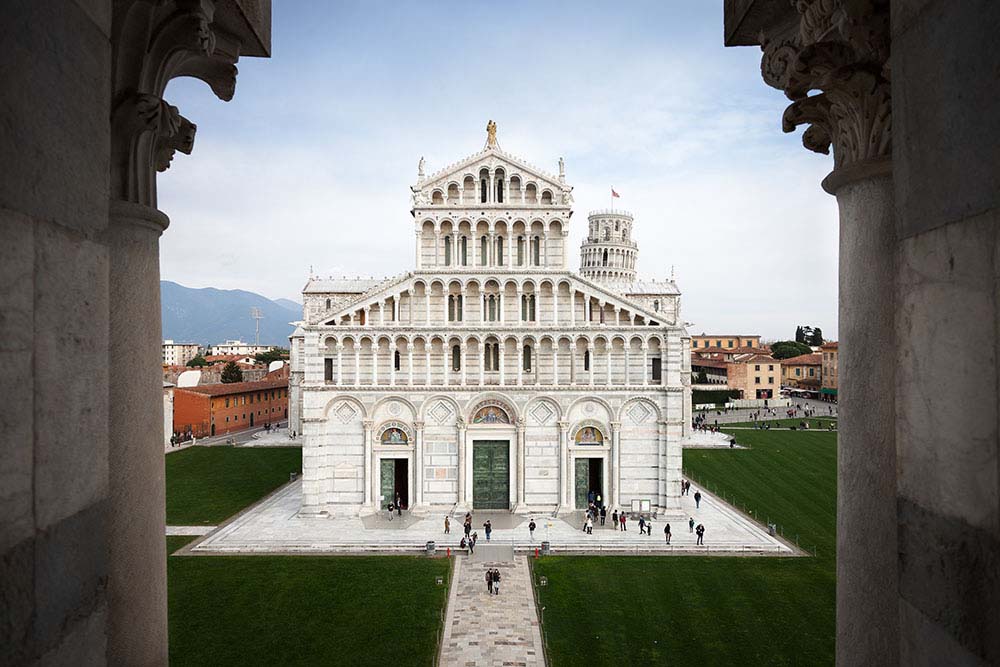
The Cathedral of Santa Maria Assunta in Pisa, the focal point of the Piazza dei Miracoli (Square of Miracles), is a masterpiece of Pisan Romanesque architecture that testifies to the wealth and power of the Maritime Republic. Founded in the 11th century to gather the Christian people in the adoration of God, it is still the “high place” where the faithful celebrate the mysteries of Christ, offering visitors an experience of inestimable artistic and spiritual value.
Architecture of the Cathedral
This sacred space was erected during an era of immense wealth for Pisa, thanks to its trade and the power of its ships in the Mediterranean. The architectural style, though enriched by Oriental influences, is derived from ancient Roman basilicas. The original design by the architect Buscheto was inspired by a central plan, featuring the figure of Christ shining from the top of a dome, typical of the Christian East. However, the current structure presents itself as a “sacred path” to be traversed, accompanied by long rows of columns, leading to Christ shining from the apse mosaic.
The Cathedral of Santa Maria Assunta in Pisa is dedicated to the Assumption of Mary, whose image, along with the beloved image of the “Madonna di sotto gli organi” (Madonna beneath the Organs), is an object of deep veneration by the Pisan faithful. The exterior, with its white marble, is part of a complex of five buildings in the Piazza dei Miracoli (Baptistery, Hospital, Tower, Cathedral, and Camposanto), which interpret the great moments of life, from birth to faith and resurrection.
The Interior of the Cathedral
The interior of the Pisa Cathedral welcomes visitors into a veritable forest of columns. The gaze is drawn upwards by the dome, painted in the seventeenth century by the Riminaldi brothers, depicting paradise with the Assumption of Mary. Along the central nave, one can observe altars of elegant Renaissance forms, works by the sculptor Stagio Stagi, featuring valuable canvases, including a Madonna by Andrea del Sarto. The walls are covered by “quadroni” (large framed paintings) created between the seventeenth and eighteenth centuries, narrating the stories of Pisan saints and the city’s endeavors.
At the center of the path is the extraordinarily beautiful pulpit (pergamo) by Giovanni Pisano. Sculpted at the beginning of the fourteenth century, this ambo, or tribune, is a sculptural masterpiece supported by symbolic figures, with panels depicting scenes from the life of Jesus and Christ the Judge of the World. Past the pulpit, one encounters the recent altar and ambo by Giuliano Vangi. The choir and apse, with their eighteenth-century altar and inlaid wooden stalls, are dominated by the great 13th-century mosaic in the basin (catino), on which Cimabue also worked, depicting Christ enthroned, surrounded by Mary and John.
The transepts house important artifacts: the right transept preserves the body of Saint Ranieri, the city’s patron, while the left transept, besides offering space for meditation, features the magnificent bronze and silver tabernacle by Battista Foggini, intended to hold the consecrated hosts.
Information for Visitors
For a complete visit to the Pisa Cathedral, it is helpful to know the opening hours. Generally, the Cathedral observes hours that vary according to the season and liturgical events. It is always advisable to consult the official website or on-site notice boards for updated times, especially during holidays or special celebrations. Access to the Cathedral is often included in cumulative tickets for the Piazza dei Miracoli.
The Cathedral of Santa Maria Assunta in Pisa is more than a monument; it is a place that invites meditation on the mystery of life and death and on the dramatic and wonderful history of humanity.