
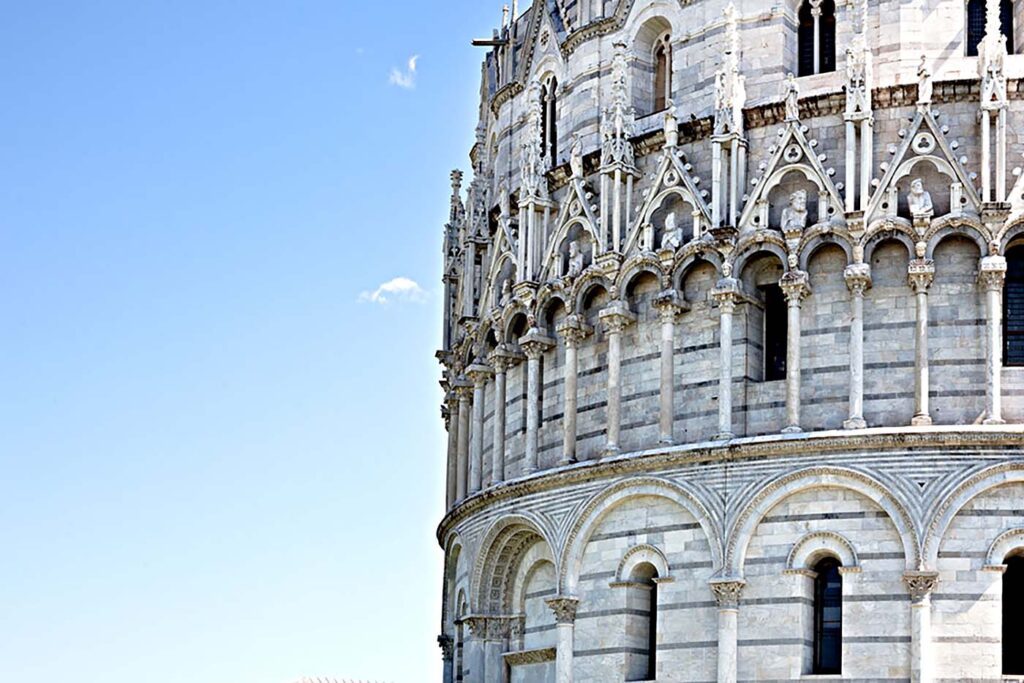
Piazza dei Miracoli, or Square of Miracles, in Pisa is a UNESCO World Heritage site renowned globally for the Leaning Tower. Yet, beyond its iconic tilt, this monumental complex—comprising the Cathedral, Baptistery, Campanile (Leaning Tower), and Camposanto Monumentale—conceals a trove of hidden secrets, fascinating tales, and architectural marvels that elevate its status from a simple tourist attraction to a deep dive into medieval history and human ingenuity.
Medieval Legends: fascinating stories
The grandeur of the square is often interwoven with captivating legends. One of the most famous surrounds the Cathedral of Santa Maria Assunta. Look closely at the marble wall of the Apse and you might spot a series of small, dark holes. Local lore whispers that these marks are the “Devil’s Claw Marks,” left by Satan himself in a fit of rage after trying to stop the construction of the sacred structure. It is said that attempting to count the holes will always yield a different number, proving the Devil’s enduring, mischievous touch on the monument.
Another legend connects the Baptistery of San Giovanni to an astronomical design. Some believe that the monuments in the piazza are positioned to reflect the constellation of the Aries, linked to the city’s ancient motto “Pisa is the Aries.” Furthermore, the earth inside the Camposanto Monumentale (Monumental Cemetery) is said to have been shipped from Golgotha, the hill where Jesus was crucified, during the Crusades, lending the site a sacred, eternal quality.
Historical Anecdotes: curiosities to discover
Beyond the fables, intriguing anecdotes highlight the square’s historical significance and unique features.
The Leaning Tower, a spectacular architectural “mistake,” is famously tied to the brilliant physicist Galileo Galilei, who was born in Pisa. It is recounted that Galileo used the Tower to conduct his experiments on gravity, demonstrating that objects of different masses fall at the same rate. A less-known anecdote involves a lamp inside the Cathedral. Legend suggests that the young Galileo observed the swinging of a large bronze lamp, leading him to formulate his theory of the isochronism of the pendulum. While the current lamp is a later replacement, the story encapsulates the site’s connection to the dawn of modern science.
Another captivating detail is the extraordinary acoustics of the Baptistery. Thanks to its double-dome design, the Baptistery produces a remarkable echo effect. Attendants often demonstrate this by singing a short note, which reverberates to sound like a haunting, heavenly choir.
Finally, the Baptistery holds a unique ritual. Students, particularly those nearing graduation, often adhere to the superstition that walking around the Baptistery while hopping on one leg will bring good luck for their final exams.
Pisa’s Piazza dei Miracoli is more than a stunning collection of buildings; it is a living canvas where history, architecture, and enduring folklore merge, inviting visitors to look beyond the tilt and uncover its centuries-old heart.