
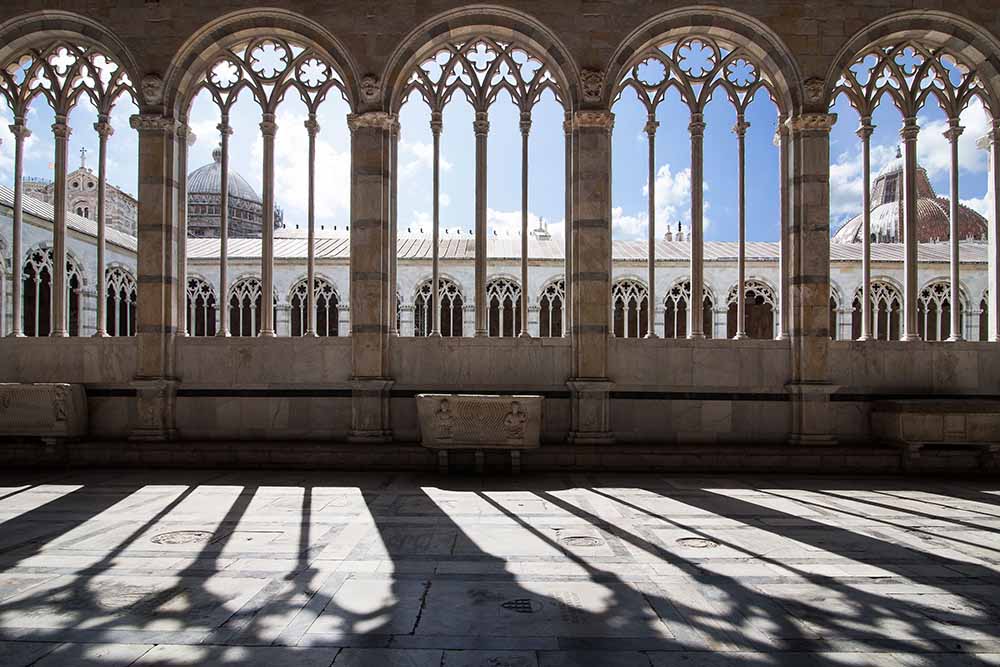
The Piazza dei Miracoli (Square of Miracles) in Pisa, a UNESCO World Heritage site, is one of Italy’s most recognizable architectural ensembles. It’s not just the iconic Leaning Tower that draws millions, but the stunning visual harmony achieved through the coexistence of distinct, yet complementary, architectural styles, primarily the Pisan Romanesque style with notable Gothic influences. This architectural dialogue tells the story of Pisa’s power and artistic prowess during the Middle Ages.
Pisan Romanesque: uniqueness and details
The dominant style across the Piazza dei Miracoli—visible in the Duomo (Cathedral), the Baptistery, and the Camposanto Monumentale (Monumental Cemetery)—is Pisan Romanesque (pisa romanic). This local variation of the broader Romanesque movement flourished between the 11th and 13th centuries and reflects Pisa’s economic and political peak as a powerful maritime republic.
Defining Features:
- Arcades and Loggias: A hallmark is the use of superimposed blind arcades on the lower levels and open loggias (small galleries) on the upper façades, creating a dynamic, layered effect. The Duomo’s façade, in particular, showcases this with four tiers of slender columns.
- Polychrome Marble: Pisan Romanesque is characterized by the use of contrasting white and colored marbles (often grey or pink), arranged in geometric patterns. This decorative technique was influenced by materials and contacts with the Islamic and Byzantine worlds, reflecting Pisa’s extensive Mediterranean trade.
- Diamond-Shaped Lozenge Motif: A recurring decorative element is the lozenge (diamond or oval) set within the arcades, adding a specific local flair.
- Classical Spolia: Evidence of Pisa’s connection to its Roman past is found in the reuse of spolia (architectural fragments from older buildings), particularly on the Duomo’s exterior.
- Elongated and Lighter Appearance: Unlike the often heavy and somber Northern European Romanesque, the Pisan style, with its many arcades and light-colored marble, appears taller, more elongated, and airy.
Gothic Influences: traces and contaminations
While the core style is Romanesque, the long construction periods for the various structures meant that later additions and modifications introduced elements of the evolving Gothic style (Pisa Gothic), leading to intriguing contaminations.
Where to Spot the Gothic:
- Baptistery’s Summit: The original Romanesque design of the Baptistery was topped off in the 14th century, long after its construction began. The elaborate upper tier of decorative pinnacles and the cuspidal dome are distinctly Gothic, featuring delicate carvings and a vertical emphasis that contrasts with the lower, rounded Romanesque forms.
- Camposanto Monumentale: Although its long, blind arcades are Romanesque, the tracery in the windows of the Camposanto displays Gothic patterns, especially in its external walls.
- Sculptural Details: The transition is also evident in the pulpits inside the Duomo and Baptistery. While the Duomo’s 11th-century pulpit was Romanesque, Nicola Pisano’s famous pulpit in the Baptistery (completed around 1260) is considered a groundbreaking work that bridged the gap, mixing classical Roman elements with the expressive, dramatic realism characteristic of early Italian Gothic sculpture. Giovanni Pisano’s later pulpit in the Duomo is even more fully Gothic in its narrative complexity and dynamic figures.
The architecture is, therefore, a living textbook. It showcases the local refinement of the Romanesque style, its unique decorative language forged by maritime trade, and the inevitable, yet elegant, integration of Gothic influences over time. The result is a piazza where diverse historical moments and artistic movements meet in perfect, dazzling unity.