
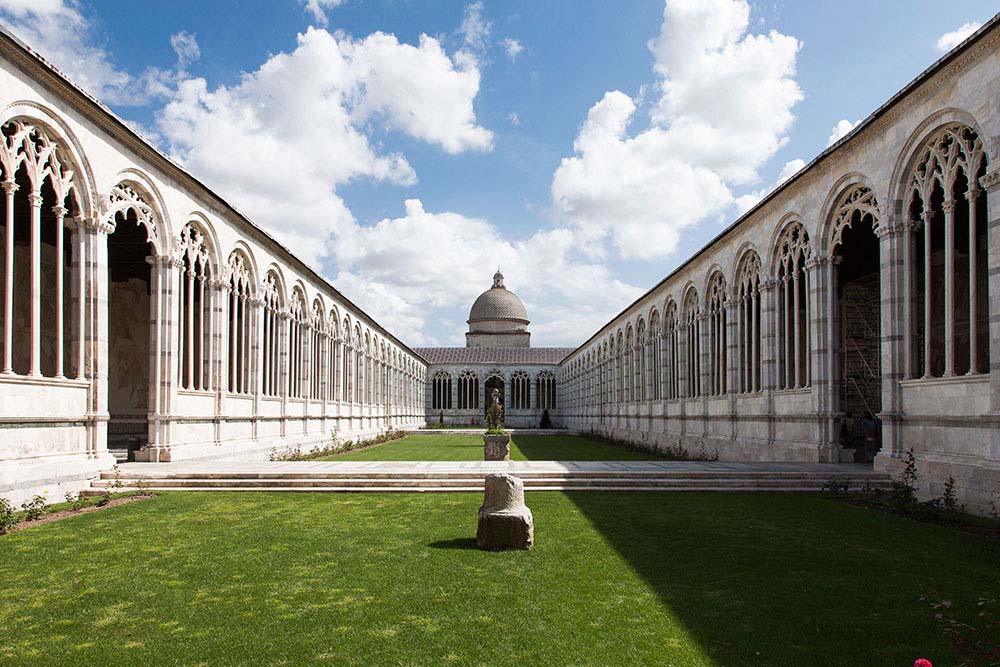
The Camposanto Monumentale (Monumental Cemetery) in Pisa is a place of extraordinary charm, guardian of an invaluable artistic heritage and centuries of history. This sacred rectangle, enclosed by marble walls and located in the Piazza dei Miracoli (Square of Miracles), is much more than a cemetery: it is a monumental cloister that, since the 13th century, has hosted the bodies of illustrious Pisan citizens in what is considered Holy Land, brought here from Palestine. The atmosphere within, amidst Gothic arches and the central green lawn, invites serenity and reflection on human destiny.
History of the Camposanto
The building of the Camposanto Monumentale in Pisa was begun in the 13th century, based on a design attributed to Giovanni di Simone, and expanded until it reached its current length of 120 meters. Its name, “Campo Santo” (Holy Field), comes from the tradition that earth from Mount Golgotha in Palestine was deposited here, so that the deceased could rest in the same soil where Jesus was buried and resurrected.
Initially, the dead were buried in the central lawn or in the floors of the galleries. Furthermore, numerous impressive Roman sarcophagi found in the Roman colony of Pisa or brought from Luni and Rome were placed along the entire perimeter, transforming the complex into a true museum ante litteram. Over the centuries, the Camposanto has suffered the fury of events: in particular, a disastrous fire following a shell hit during the Second World War severely damaged the building. The molten lead from the roof destroyed the floors and irremediably compromised a large part of the frescoes. Despite this, recent and meticulous restorations have allowed for the recovery and repositioning of many of these works, partially restoring their original beauty.
The Camposanto Frescoes
The interior walls of the Camposanto are famous for their vast and complex pictorial decoration, whose creation spanned from the mid-14th century until the late 17th century, involving masters of the highest level. These frescoes were a kind of “painted sermon” intended to educate and admonish the faithful on the themes of death, divine judgment, and redemption.
In the south wing, the pictorial cycles began with the Florentine Buffalmacco, author of the celebrated Triumph of Death in the first half of the 14th century. This work, a warning against wealth and dissoluteness, depicts Death with bat wings swooping down on a joyful company of young people, while a group of knights is horrified before three corpses in different states of decomposition. It is flanked by the Last Judgement and Hell, in addition to the proposal of the austere life of the Anchorites. These are followed by the Stories of Saint Ranieri (patron of the city) by Antonio Veneziano and Andrea di Buonaiuto, and the Stories of Job, which complete the south wing.
In the north wing, however, later cycles can be admired. Piero di Puccio, at the end of the 14th century, painted the famous representation of the Mappamondo (World Map) and the first Stories of Genesis. The biblical narrative was later taken up and masterfully developed by Benozzo Gozzoli and his workshop, starting in the 15th century, with the Stories from the Old Testament. Gozzoli, with his attention to perspective and richness of detail, was able to infuse the scenes with a luxurious and joyous atmosphere, marking an important stylistic change compared to the dramatic 14th century.
How to Visit the Camposanto
A visit to the Camposanto Monumentale in Pisa is a fundamental stop for anyone going to the Piazza dei Miracoli. It is advisable to dedicate sufficient time to contemplation, both to admire the Gothic architecture of the cloister, the tall quatrefoil windows opening onto the lawn, and to meditate on the narrative power of the frescoes.
The complex also houses the Dal Pozzo Chapel (erected in 1594), which today holds numerous relics. The walls are also decorated with subsequent-era memorial stones and funerary monuments. Inside, one can also notice, in the center of the western wall, the ancient chains of the Pisan port, removed by the Genoese in 1290 and returned to Pisa in 1848, symbolizing rediscovered national unity and reconciliation.
For a complete visit to the Camposanto Monumentale, it is recommended to purchase a cumulative ticket that also includes access to the other monuments in the Piazza dei Miracoli (Leaning Tower, Baptistery, Cathedral, and Museum of the Sinopie), managed by the Opera della Primaziale Pisana. Updated information on hours and prices can be found on the official website.